GitKB Enterprise

Scale agentic engineering across your organization.

Your AI engineering investment compounds instead of resetting every session. GitKB gives agents reusable project context, auditable history, and code intelligence — beside your application repositories, not inside them.

Up to 85%

less repeated context discovery in early pilots

100%

of knowledge changes reviewable by commit, author, and diff

0

specs, tasks, or context docs added to your application repos

Local-first architecture. Self-hosted, on-prem, or private cloud. No vendor lock-in — your knowledge never leaves your control.

Why not the status quo?

Enterprise AI adoption needs more than wikis, IDE memory, and chat history.

Wikis and docs rot

They capture intention once, then drift from the code and the work actually happening.

IDE memory dies with the session

A great AI interaction still leaves the organization with no reusable knowledge asset.

Domain knowledge lives in black boxes

Critical understanding is scattered across third-party databases and APIs your agents can't reach or reason over.

Why now

AI coding is moving from individual productivity to company operating model.

The next bottleneck is not model capability. It is whether each session starts with the right context and leaves behind knowledge the next session can reuse.

Most organizations are generating more AI-assisted code than ever — but the reasoning, decisions, and context behind that work disappears with every session reset.

Context recovery

Up to 85% less repeated discovery

Agents start with prior decisions and active context instead of re-reading the repo.

Token spend

Fewer tokens on rediscovery

Code intelligence and call graphs replace blind file reads.

Review quality

Risky changes caught before commit

Impact analysis shows the blast radius before changes ship.

Knowledge reuse

Session output becomes reusable context

Useful work feeds the next engineer or agent automatically.

Practical adoption

A protocol agents can run from the command line.

GitKB fits into the engineering loop your teams already use. Agents inspect code intelligence, capture decisions, preview graph changes, and sync knowledge to the organization — without adding Markdown docs to application repos.

49 MCP tools. Works with Claude Code, Cursor, Codex, and any MCP-compatible agent — no custom integration required.

Evidence

A compounding graph of engineering knowledge, not another pile of prompts.

Every useful session makes the next one cheaper and more effective. GitKB captures tasks, decisions, code relationships, and audit history as reusable context that scales across the organization.

Pain point: every session starts cold

Agents start with real project context, not a cold read of the repo.

GitKB turns specs, tasks, rollout plans, and architecture decisions into structured project knowledge — with goals, acceptance criteria, and typed relationships. Engineers and agents share context the same way they share code: push, pull, and sync across repositories and teams.
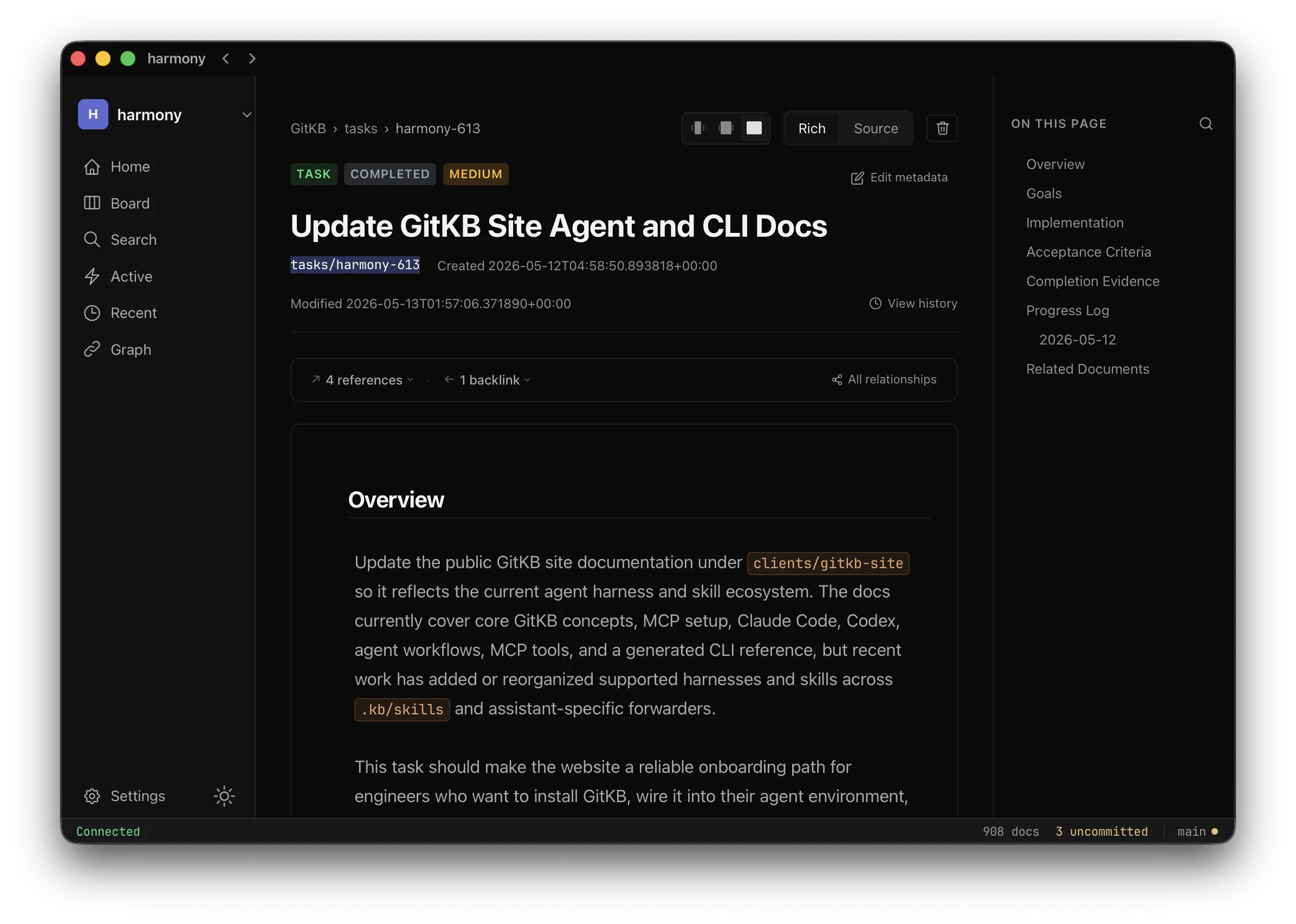
GitKB desktop document view showing a task as first-class reusable project knowledge.
The takeaway

Project knowledge is structured, versioned, and shared through familiar push/pull workflows — not copy-pasted between chat windows.
Pain point: AI work is hard to audit

Every knowledge change records who changed what, when, and why.

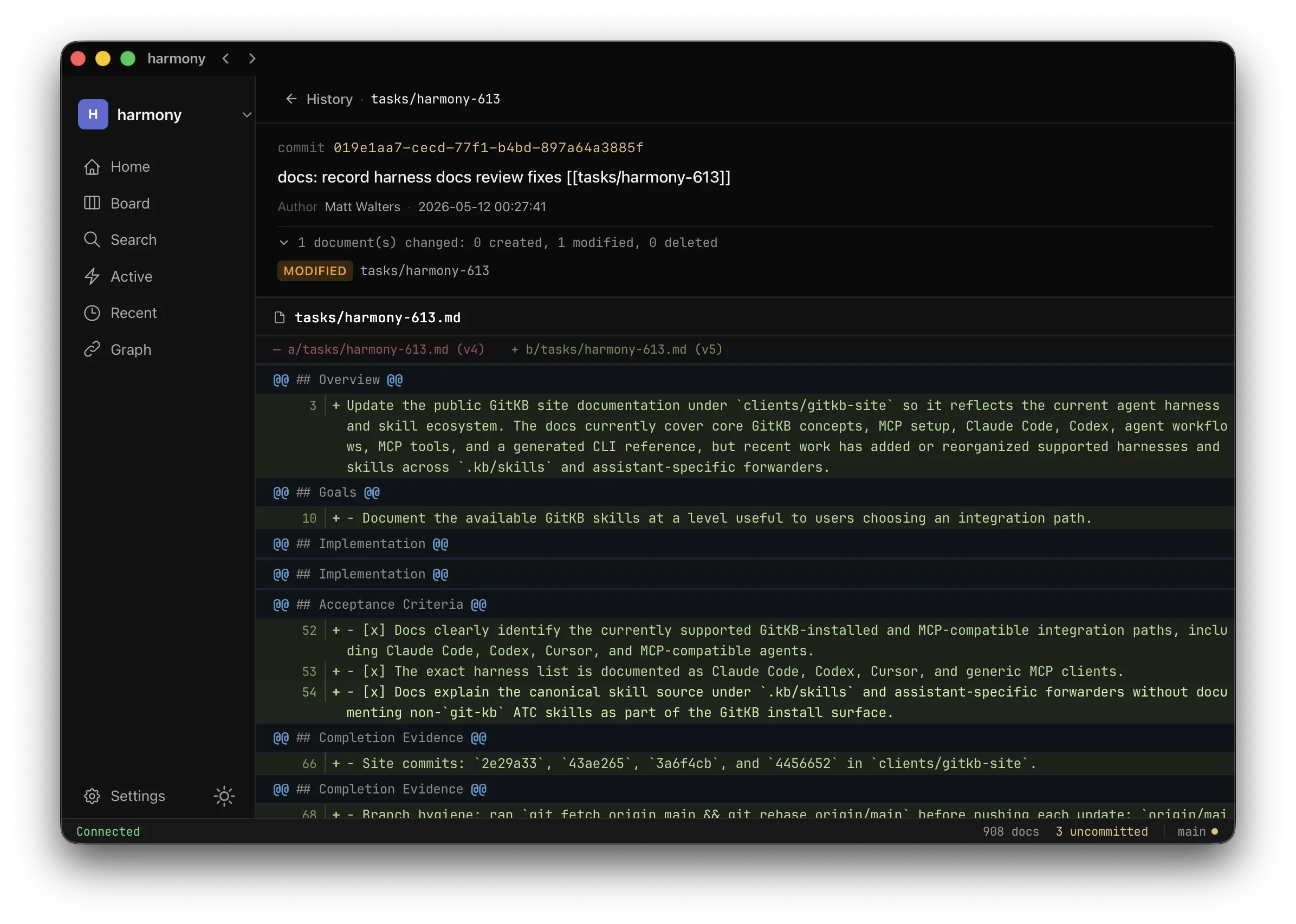
Enterprise teams need to know what changed and who decided it. GitKB records knowledge changes as durable commits with author metadata and line-level diffs, so AI-assisted work has an inspection trail.

GitKB desktop commit detail showing an auditable knowledge change with commit metadata and a line-level diff.
The takeaway

Every knowledge commit captures author, timestamp, changed document, and a reviewable diff.

Pain point: decisions scatter across tools and time

A timeline of engineering decisions that survives handoffs and model resets.

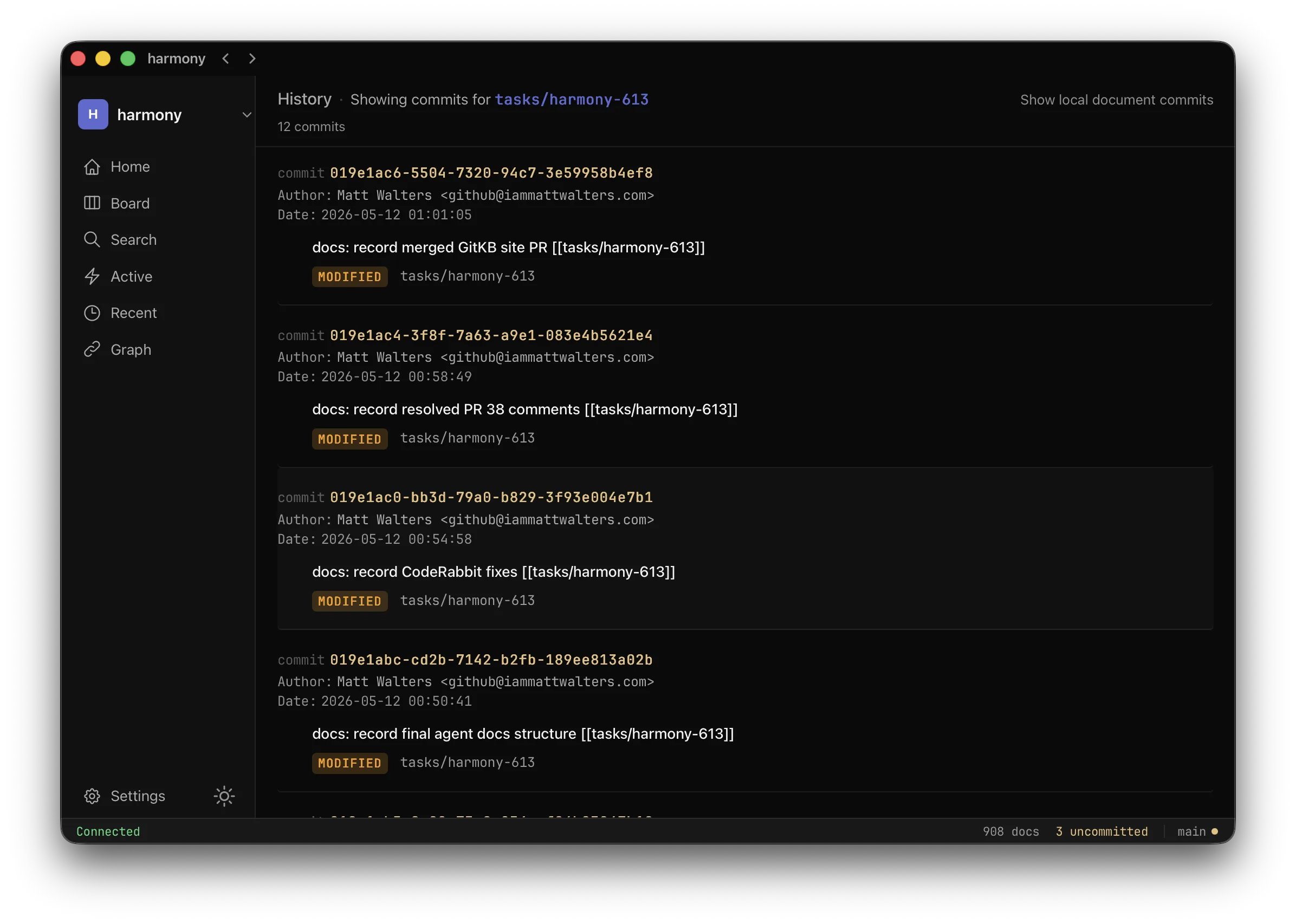
One commit tells you what changed. A commit chain tells you how a decision evolved — across weeks, team rotations, and model resets. GitKB preserves the full timeline so the reasoning behind your architecture is never lost, even when the people who made those decisions have moved on.

GitKB desktop history view showing repeated knowledge commits for a task over time.
The takeaway

Institutional memory becomes a reviewable timeline — not tribal knowledge that leaves when engineers do.

Pain point: knowledge does not compound across sessions and teams

A distributed graph where every session increases the ROI of the next.

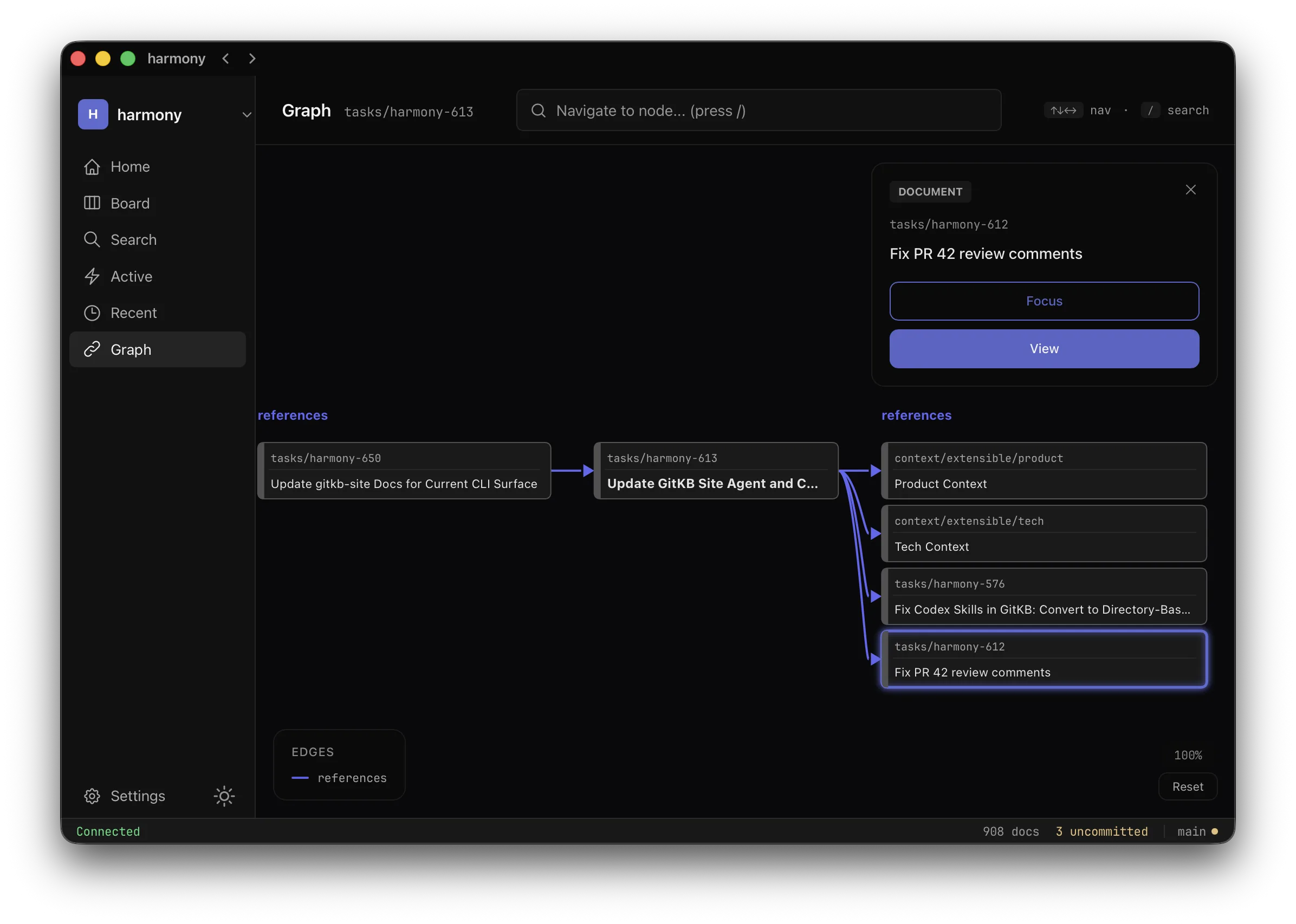
The value of one session does not end when the context window closes. GitKB connects strategy, tasks, context, and decisions through typed relationships that agents traverse to rediscover curated, related knowledge when they need it. Because sync is sparse and per-document, the graph scales to organizational size with many agents and teams working across different areas at the same time.

GitKB desktop graph view showing relationships between strategy, task, and document nodes.
The takeaway

Typed relationships let agents traverse from strategy to tasks to context automatically — across a graph that grows with the organization, not against it.

Operating model

How GitKB makes agentic engineering work at company scale.

Domain knowledge is scattered across third-party tools your agents can't reach. GitKB centralizes it into a workspace where the cutting edge of your engineering understanding takes shape — then connects it into a distributed graph that improves the context, auditability, and ROI of every future session.

01

Install locally, no migration required

GitKB runs beside your existing repositories and tools. One binary, no infrastructure, no disruption to current workflows.

02

Agents get structural code intelligence and prior knowledge

Call graphs, blast radius, active tasks, prior decisions, and open specs — loaded before the first line of code is written.

03

Knowledge syncs through push and pull

Teams share context using the same workflows they use for code. Per-document sync means agents and teams work concurrently without conflicts.

04

Leadership gets an audit trail outside the codebase

Every knowledge change is a versioned commit — reviewable, searchable, and separate from your application repositories.

Enterprise readiness

Enterprise scale without repo pollution.

Your knowledge never leaves your infrastructure unless you choose to sync. GitKB is local-first by architecture — works offline, in air-gapped environments, and in secure facilities. Deploy as local CLI, private cloud, or fully self-hosted. Read our security practices.

Markdown-native storage — no vendor lock-in, pull your knowledge anywhere
Versioned history for knowledge and decision changes
First-class code intelligence to reduce context-window waste
Distributed graph that compounds across teams and repositories
Private hosted, self-hosted, and on-prem deployment paths
SSO / SAML / OIDC and data ownership review

30-day pilot

Prove agentic-session ROI before broad rollout.

In 30 days, your pilot team will see shorter ramp-up times, lower token spend, auditable knowledge output, and a reusable context layer that grows with every session.

Book a Demo

Use cases

Where GitKB changes the economics of agentic engineering.

Company-wide AI coding rollout

Every team invents its own prompt rituals. Every agent starts from a cold read of the repo.

Teams share a distributed graph of tasks, decisions, code intelligence, and reusable session context.

Platform modernization

Cross-repo migrations rely on tribal knowledge and repeated impact analysis.

Agents start with call graphs, prior decisions, owners, and risk notes before proposing changes.

Regulated engineering work

AI-assisted changes are hard to trace back to context, ownership, and review decisions.

Session output and knowledge updates become auditable records outside application repositories.

Book a Demo

See how GitKB fits your engineering workflow in 30 minutes.

Every demo starts from your real workflow — your repos, your team structure, your agent tooling.

Book a GitKB Demo

Tell us about your engineering organization and we will come prepared with a focused pilot and deployment conversation.

About you

Tell us who you are.

1. About you2. Your team3. Use case4. Enterprise needs